Harbingers of spring,
the sound of oystercatchers
whistling in the dark.
We went up to the university last night to see Chico and Rita (not as good as the hype - showing nudity and drug-taking doesn't make animation 'adult'), and as we left the car park the air was full of the whistling of returning oyster-catchers. They nest on the flat roofs during the spring and they are incredibly noisy, especially at night. In gaelic the are known as ghille-bridhe (the servants of Bridget) because they usually arrive round about her feast day, which is why they are also called Bride's chickens.
Monday, 14 February 2011

Friday, 11 February 2011
As Above So Below

The cloud on the hill drifts down
to meet the damp green on the grass
the wet tarmac, disintegrating leaves
despondent gardens
Tuesday, 8 February 2011
First day of real gardening
The weather was so nice at the weekend. I got all the pots tidied up

and on Sunday we went to buy potting compost, - and a few other things---

and today was going to be the day when things got moving. I was going to plant the witch hazel and the aconites, set out the garlic I bought back in November just before the frost and snow, and maybe start some early potatoes in the greenhouse.
I was defeated by the frost last night - not a very hard one, but enough to persuade me that it wasn't a good time to take risks. I did get some clearing up done, however, and in the course of it I found that some things have already heard the starting whistle:

These bright red shoots are elecampane. It will get to over six feet high and have bright yellow flowers like disshevelled daisies in the summer.Basically it is an aspirational dandelion, but it's cheerful and easy - and look at that red! I found it growing wild near the ruins of St Brendan's monastery on Eilach a Naoimh once, cut very short by the winds; it may have been deliberately planted, as it had some herbal value - the roots were used for cough cures.

I'm really thrilled to find this pot looking so lively. The bright green leaves are hyssop, a mediterranean herb which really doesn't like damp and which has failed me several years in the ground. The cold this winter doesn't seem to have been nearly such a big problem as sitting about in mild wet soil in previous years.
Friday, 4 February 2011
Of Gods and Men directed by Xavier Beauvois
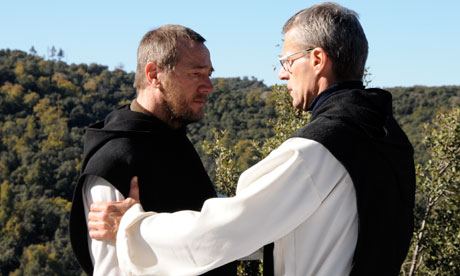
I went to see the film Of Gods and Men last night. Chretien de Chergé has been one of my heroes since his Testament was published. I'd put a link to this remarkable document except that it's only available in French, for some reason I don't understand!
The film reminded me of the gentle charming Etre et Avoir in its quiet fragmentary build-up of the relations between characters but the themes are so much darker. The monks of the Atlas Mountain monastery are caught between the violence of terrorists and the aggression of the army - and to this day no-one knows for certain which side killed them.
Dome Donald McGlynn of Nunraw Abbey tells the full story here. he was responsible for publishing a lot of the background information about the monastery, and it was noticeable how close the film kept to this material.
The other thing I noticed about the film was its restraint. There was no taking of sides. There was no glossing over the divisions between the monks as life got more dangerous. They were shown as well-meaning, but not too wise, brave, but not noble, good but perhaps not always right. There was very little violence. There was no way of identifying the killers, whose faces were alwys in shadow. And at the end we did not see the deaths. Monks and kidnappers quietly disappeared into the snow.
Two shots will always stand out for me. One is the taking of a photograph in the last peaceful days before the end. All the monks are standing together in the sunshine, smiling. I have a copy of the real photo on prayer cards -it is so close to that shot. It must have been a labour of love. And the other is when the monks are singing an Easter litugy, almost but not quite drowned out by the sound of the helicopter above. Gradually the brothers come together, their arms around each other, proclaiming the persistence of light and hope.
Sometimes the enemy of your enemy is not your friend. Sometimes the way we defend ourselves is more dangerous than the gullibility of being trusting and compassionate.
Yesterday on Facebook the poet Andrew Philip posted this
picture of Christians protecting Muslims at prayer in Liberation Square in Egypt, and reminded us that at Christmas there were Muslims protecting Christian churches during the services. It's important to realise that this can happen, the value of honouring other people's beliefs whether we share them or not.
As for the rest of us, we stumble and get up again, stumble and get up again. And learn to forgive ourselves and each other, every time.
Thursday, 3 February 2011
New month, new season
This was Tuesday. look at it, all new buds and promises

The jasmine on the yard had another go at flowering -

the pond had no ice for the first time in over two months

But this morning it was snowing again. There's not much at this level, and what there is, is melting fast, but the hills are all outlined in white again, and up north the traffic is having a hard time.
By the river things are looking battered and bleak.

It will take a week or two for the new growth to green up. But there's something in the air. The migrating birds are beginning to get restless and there was a blackbird near the top of a sapling rowan tuning up for the coming spring.
Tuesday, 1 February 2011
Slokt by Sea by Nalini Paul

Slokt by Sea was also launched by Red Squirrel on 17th January. It grew out of nalini Paul's year in residence in Orkney as George Mackay Brown Writing Fellow. It's a quiet book, a bit disenegaged for my taste at the moment, but full of good things.The word 'slokt' means drenched, or quenched, and the book is thoroughly soaked in Nalini Paul's engagement with the sea, from a first encounter with high water crossing the Churchill barriers to a distant view of the Old Man of Hoy. It is full of music Lark Ascending, Danse Macabre and traditional Orkney fiddle music, and haunted by the legendary selkies - the seal-people, human on land and seal in the sea.
She is very conscious of landscape and weather. There is rain:
Sheets of rain sweep over the streets
against flats
into gutters
saturating leaves
and wind, peat and birds. I love her snapshot of gannets off Lerwick;
scissors fold shut
before the plunge
and the night sky:
a bowl of hidden stars
and the way she uses colours and textures, as in the first poem Moth, or in Sunshine in the Hope. I hope there are more Orkney poems to come.
Defragmenting Sappho by Kevin Cadwallender

It's two weeks since Red Squirrel launched Kevin Cadwallender's new book, Defragmenting Sappho so it's more than time I reviewed it, especially since I had it read by the time I got home that night.
Kevin is known for his excellent performance poetry, very funny, very well-performed, but also thought-provoking and extremely intelligent. And though the launch was also a brilliant performance, with music and readings by fellow-poet Sophia Walker, no-one was really ready for the new departure this book is.
Essentially Kevin Cadwallender has reconstructed poems from the fragments which are all we have from the 7th century BC poet Sappho. He studied them intensely in the translations of Anne carson, deliberately restricting his vocabulary to what is known of hers, and producing sixty new composite poems.
The result is passionate, tender, lyrical. Sappho praises, teases, reproaches, remembers lost loves, entices new ones, confronts old age, infidelity and mortality
Someone will remember us, I say,
even in another time
when our bones are whiter than an egg (58).
Sometimes there is a lot to work with - as in the above example. Occasionally there is very little:
Sunset stoops over the hill
slowly like an old man
putting out fire.
(the italicised words are Sappho's)
It is moving, astonishing, a little bit obsessive. It's brilliant.
Subscribe to:
Posts (Atom)